


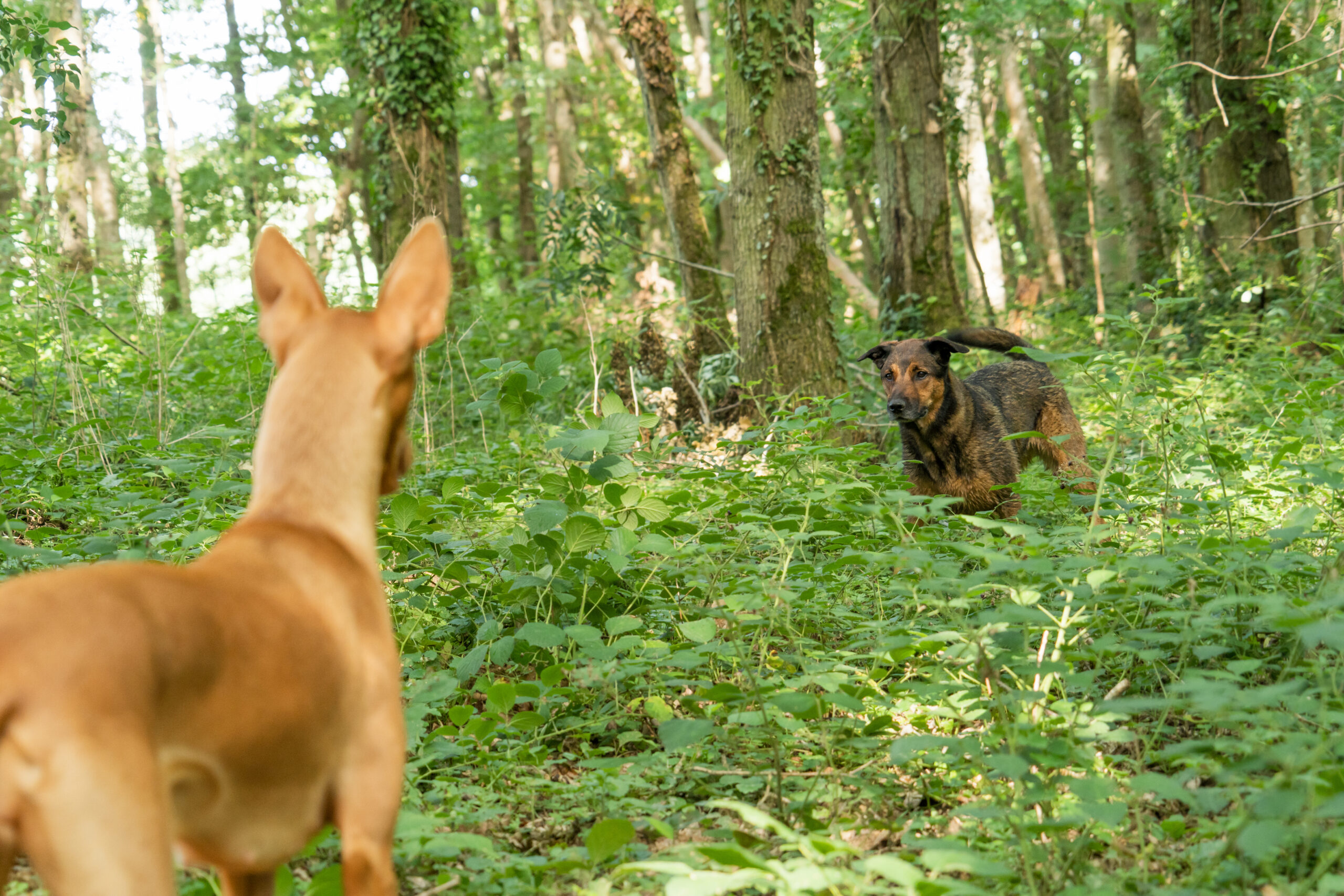
But what few people realise is that truly meeting a dog’s needs is not simply about ticking boxes. It is a subtle balance between biology, behaviour and the human relationship. In this article, we get to the heart of the subject, with scientific references to support the discussion.
1. The need for emotional security: the forgotten foundation
Long before the daily walk, a dog’s fundamental need is emotional security. According to the work of Dr John Paul Scott, ethologist and behavioural geneticist (Scott & Fuller, 1965), dogs develop attachment patterns similar to those seen in human children. This means that a dog that is stressed, isolated or exposed to frequent changes can develop behavioural problems such as hyper-attachment, aggression or depression.
👉 A dog needs a stable, predictable environment where they know what is going to happen. This comes through routines, but also through regular positive interactions with people or other dogs.
2. Regulating energy: it is not only physical
Yes, a dog needs exercise. But not only by running after a ball. Dr Marc Bekoff, behavioural biologist at the University of Colorado, showed in 2001 that mental activity and social stimulation are just as important as physical exercise for a dog’s wellbeing.
Examples of regulating activities:
- A “sniffing walk” — a free, unguided scent walk
- Food-search games such as snuffle mats and puzzle feeders
- Supervised social interaction with other well-balanced dogs
A mentally tired dog sleeps better, is calmer and develops fewer destructive behaviours.
3. The need to belong to a group
The dog is a social animal. Its ancestor, the wolf, lives in a pack. Although domesticated, the dog retains this fundamental need to belong to a “group”. A 2015 study led by Professor Clive Wynne (Arizona State University) highlights that dogs seek not only human presence, but a sense of active inclusion.
What does that mean? Leaving a dog alone for nine hours a day, even with water and food, does not meet their social needs.
This need for inclusion is expressed through frequent interaction, physical contact, shared play and the opportunity to be with other dogs.
4. The importance of control and autonomy
Dogs, like humans, need to be able to make choices. In a fascinating 2020 study, researcher Charlotte Duranton (Aix-Marseille University) showed that dogs given more control over their environment — choosing toys, the type of interaction or when to go outside — develop less stress and are more cooperative.
What this means in practice:
- Let the dog choose the walking route
- Offer several possible activities
- Do not force interaction if the dog shows signs of tiredness or lack of interest
5. Regular access to new experiences
Canine neuroplasticity is stimulated by novelty. A dog’s brain needs to be surprised and challenged. Environmental enrichment, new smells, new textures and new places not only help develop cognitive skills, but also reduce stereotypical behaviours such as pacing, compulsive licking and repetitive barking.
In summary
Meeting a dog’s daily needs means much more than a bowl of food and two 30-minute walks. It means offering a secure environment, social interaction, mental stimulation, the ability to make choices and the opportunity to discover the world at their own pace. Understanding and respecting these needs helps support their balance and enjoyment of life — and builds a strong, lasting and healthy relationship with them.
📚 Scientific references
Scott, J.P. & Fuller, J.L. (1965). Genetics and the Social Behavior of the Dog.
Bekoff, M. (2001). Social play behavior: cooperation, fairness, trust.
Wynne, C.D.L. et al. (2015). The social nature of dogs.
Duranton, C. (2020). Choice and control in dogs: how agency reduces stress in domesticated animals.