


Moving to Paris with a dog sounds romantic until you start thinking about the paperwork, the flight, the apartment, the métro, the parks and what happens on the first long workday after you arrive.
The good news is that Paris can work very well with a dog. The key is to separate the move into three simple jobs: enter France legally, learn the local rules, then build a reliable daily routine.
The short version
Paris can be dog-friendly. It just isn’t dog-simple.
Before you move, get the entry documents right. During your first week, learn the leash, park and transport rules. Before work and travel start filling your calendar, choose a vet and decide what you will do for walking, daycare and boarding.
Moving to Paris with a dog: your 3-stage plan
1. Before the flight
Microchip, rabies vaccination, the correct travel document and any country-specific requirements.
2. Your first week
Find a vet, understand Paris rules, register the dog locally if appropriate and identify nearby walking areas.
3. Your normal life
Build a realistic routine for workdays, weekends and holidays before you urgently need a dog service.
Bringing a dog to France: start with where you are coming from
France follows the European Union’s pet-movement rules. The details change according to the country your dog is travelling from, so do not rely on a checklist written for someone moving from a different country.
| Where your dog is coming from | Typical document | What to check |
|---|---|---|
| EU country / Northern Ireland | Valid EU pet passport | Microchip and valid rabies vaccination. |
| Listed non-EU country Including the United States and Great Britain |
EU animal health certificate in most cases | Microchip, valid rabies vaccination and the current certificate rules. A rabies antibody titre is generally not required for countries on the EU/French listed-country route, but transit can matter. |
| Other non-EU country | EU animal health certificate | Microchip, rabies vaccination and potentially a rabies antibody titre with mandatory timing before entry. |
The safest starting point is the European Union’s official pet-travel guide. France’s customs authority also publishes the current requirements for travelling to France with a dog, cat or ferret.
The four details that create most problems
- The microchip needs to come before the rabies vaccination for that vaccination to be recognised for travel.
- After a first rabies vaccination, the official French guidance requires a waiting period before travel.
- Dogs arriving from a non-EU country normally need the appropriate EU animal health certificate issued within the required pre-travel window.
- If your route starts in a country for which a rabies antibody titre is required, the blood test and waiting period need to be planned months ahead.
Coming from the US or Great Britain? Both are currently on the French list of countries for which the rabies antibody titre is not normally required. You still need to follow the microchip, rabies and health-certificate rules. Always check the official source shortly before travel because pet-entry rules can change.
One extra check for certain breeds and types
France has special rules for dogs classed as category 1 or category 2. Category 1 dogs are prohibited from being imported into France, while category 2 dogs are subject to specific legal obligations. If your dog is an American Staffordshire-type, Mastiff-type, Tosa or Rottweiler-type dog, do not assume that paperwork from your home country settles the French classification. Check the French Customs guidance before booking travel.
Once you arrive: the Paris dog rules expats notice first
The culture can feel relaxed around dogs, but the rules are more precise than many newcomers expect.
🦮 Public space
Paris requires dogs to be kept on a leash in public space.
🌳 Parks
Dogs are not automatically allowed in every park. Paris lists specific green spaces and dog areas where they are admitted under stated conditions.
🧹 Waste
You must pick up after your dog. The City of Paris currently states a €135 fine for failure to do so.
🚇 Public transport
Small dogs travel in a closed carrier. Larger dogs are accepted on the métro and RER if leashed and muzzled, but not on buses or trams.
The City of Paris maintains an official page on dog-friendly green spaces. For transport, check the RATP’s current pet rules.
Your first-week dog checklist in Paris
Do these before life gets busy:
✓ Choose a local veterinarian and save an emergency contact.
✓ Ask the vet about registering your dog’s foreign identification with I-CAD if you are settling in France.
✓ Identify two nearby dog-friendly walking areas rather than assuming the closest park accepts dogs.
✓ Buy a muzzle if your larger dog will use the métro or RER.
✓ Test your weekday routine before your first full day at work.
✓ Visit any daycare or boarding facility before you urgently need it.
I-CAD, the French national identification database for domestic carnivores, explains the process for registering an imported animal’s identification in France. A French veterinarian can help you with the procedure.
Dog services in Paris: what should you organise first?
When people search for dog services in Paris, they often start with a dog walker. For a new expat, the more useful question is: which service removes the next predictable problem from my calendar?
| Service | Set it up when… | What to ask |
|---|---|---|
| Vet | Immediately | English communication, emergency process, I-CAD registration. |
| Dog walker | For occasional midday relief | Solo or group walk, duration, transport, insurance and handling approach. |
| Dog daycare | For regular full workdays | Group size, compatibility assessment, rest, supervision and pick-up. |
| Dog boarding | Before your first trip | Where your dog sleeps, overnight presence, food, activities, updates and veterinary protocol. |
What surprises many dog-owning expats about Paris
A smaller apartment is not automatically the problem. A dog can live very well in a Paris apartment if their daily needs for movement, sniffing, social contact, rest and mental stimulation are met. A large home does not replace those needs either.
“Dog-friendly” does not mean “off-leash everywhere.” Café culture may feel relaxed, but public-space and park rules still apply.
Your commute changes your dog-care maths. A 30-minute midday walk may be enough for one dog and nowhere near enough for another. If your dog enjoys social company and outdoor activity, a full daycare day can be a better fit than stacking short visits.
Holiday boarding should not be a last-minute search. Good facilities often have an onboarding process, vaccination requirements and a behavioural assessment. Visit early, when you have time to decide rather than when your flight is already booked.
If you need dog daycare or boarding from Paris
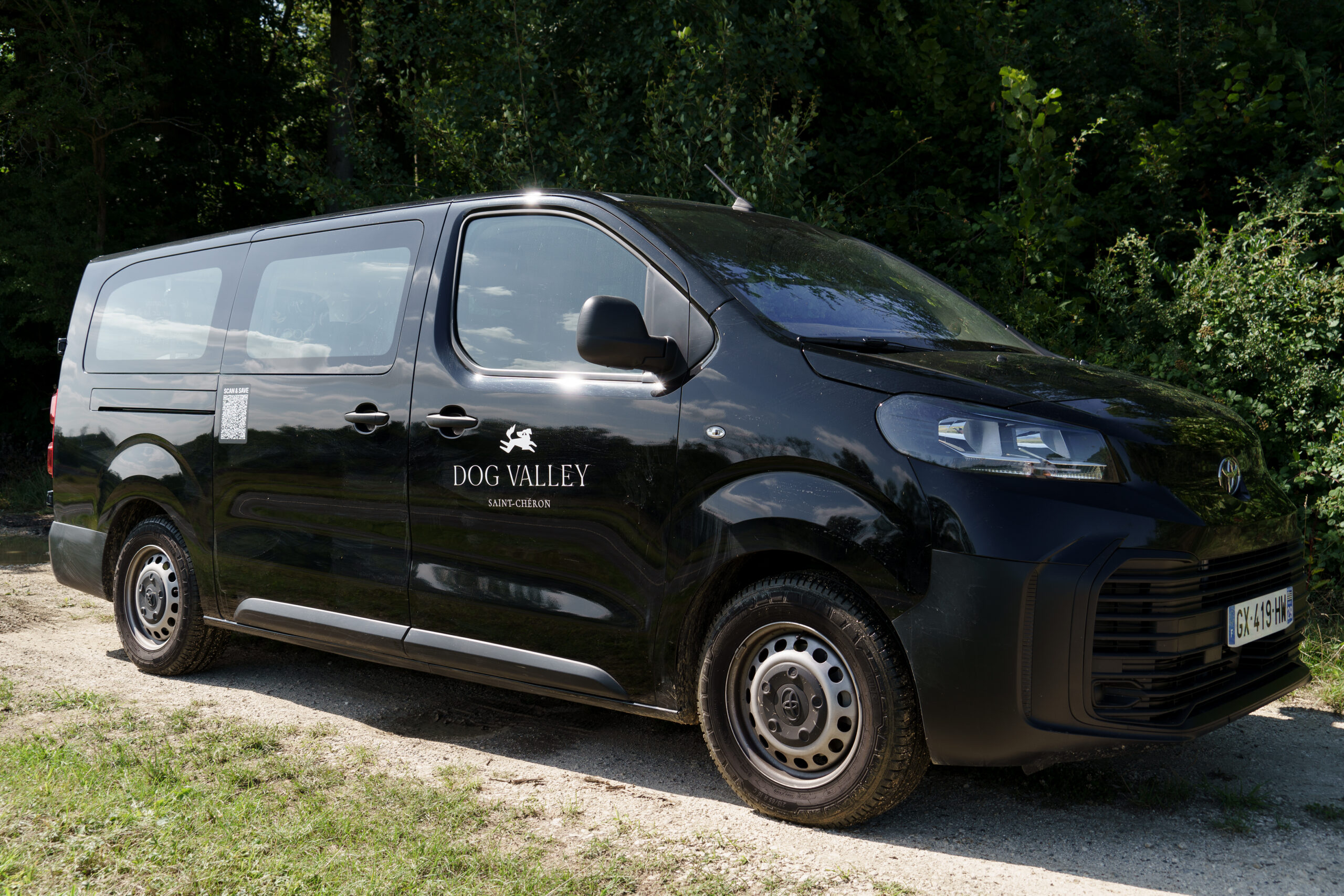
Dog Valley was created for exactly the logistical problem many Paris-based owners face: giving a dog a real day outdoors without adding a long drive to the owner’s schedule.
Our dog daycare for Paris takes place across five hectares of secure natural grounds near Paris, with daycare groups limited to seven dogs maximum. Our dog boarding includes private 10 m² air-conditioned suites, meals and daytime activities. Transport is included within our standard pick-up area, with details on our Paris dog transport page.
It will not suit every dog. We assess dogs before confirming membership, because a social group environment needs to be right for the individual dog as well as the group.
The goal is not to make your dog fit Paris.
It is to build a Paris routine that still lets your dog be a dog.
Official resources to bookmark
- European Union — travelling with pets and other animals
- French Customs — travelling with a dog, cat or ferret
- City of Paris — dog-friendly green spaces
- RATP — travelling with an animal
- I-CAD — registering an imported animal
FAQ: moving to Paris with a dog
Can I bring my dog from the United States to France?
Yes, provided the dog meets the current EU and French entry requirements. The United States is currently on the French list that normally exempts dogs from the rabies antibody titre, but microchip, valid rabies vaccination and the correct EU animal health certificate remain important. Check French Customs before travelling.
Do dogs have to be on a leash in Paris?
Yes. The City of Paris states that dogs must be kept on a leash in public space. Access to green spaces is not universal, so check the city’s current list of dog-friendly parks and canine areas.
Can dogs ride the Paris métro?
Yes, under conditions. Small dogs can travel in a closed carrier. Larger dogs are accepted on the métro and RER when leashed and muzzled; current RATP rules do not allow larger dogs on buses and trams.
Do I need a French pet passport after moving?
Your entry document depends on where you are arriving from. If you become an EU resident, an authorised veterinarian can advise you about an EU pet passport for future EU travel. For the move itself, follow the document rules that apply to your country of departure.
Rules checked in October 2026. Pet-entry and transport requirements can change. Official government and transport-operator guidance should always take precedence over this article.